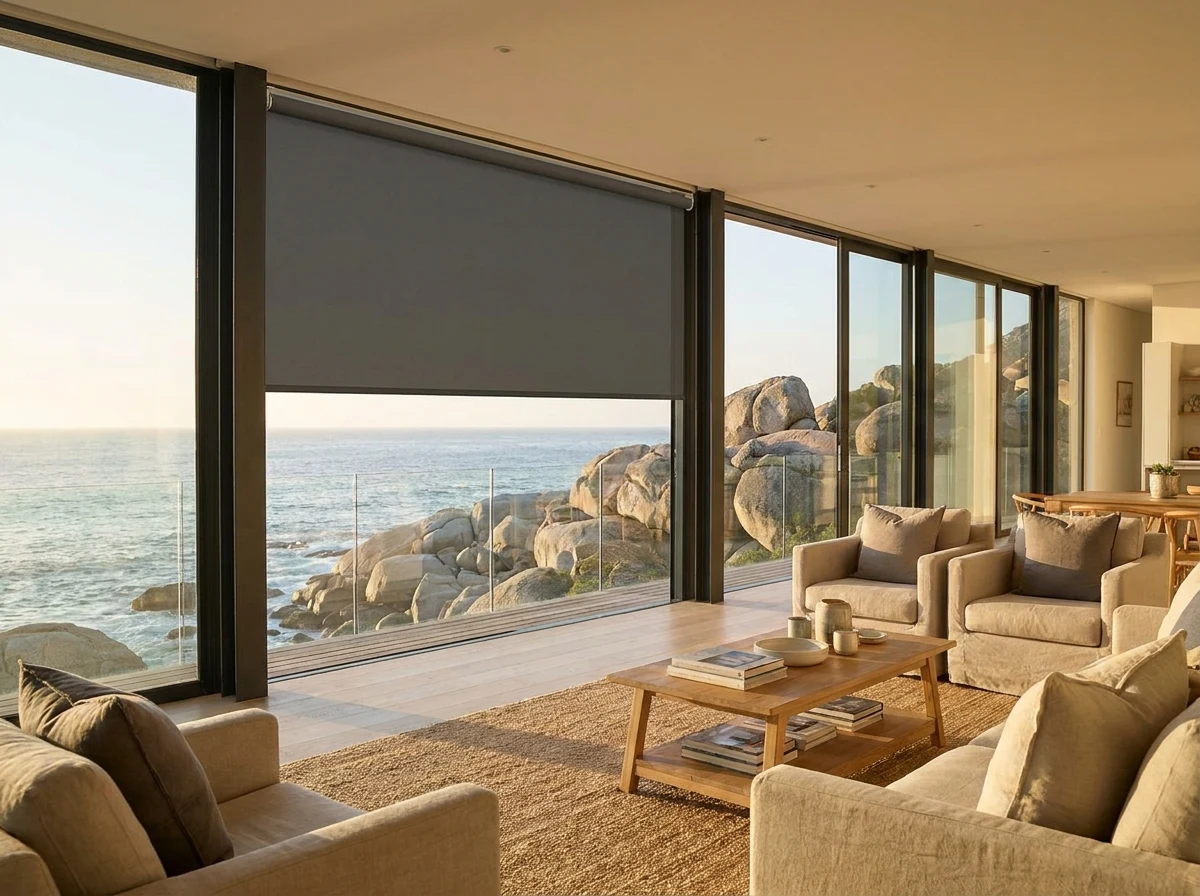
Four in the afternoon is the test in this valley. The sun sits low over the water, comes in almost sideways under every overhang, and a roller is usually the quietest fix for it — as long as the cloth was chosen for that particular window and not for the house in general.
Half-drop on a Llandudno corner window — enough to take the low sun off the seating, not enough to lose the boulders.
There is almost nothing to a roller blind. One panel of cloth, one aluminium tube, two brackets. Which is exactly why so much rides on two decisions — the fabric, and how it is mounted. Made well for the opening it is actually going on, you stop seeing it within a week. Made carelessly, you end up with something you leave permanently at half-mast because it never quite does either job.
Openness, in plain numbers
Sunscreen cloth is rated by openness factor: the share of the weave that is hole rather than yarn. It is the most useful number you can hold in your head standing in front of a west elevation here.
1–3% — the hardest cut of glare and UV. The view drops to a soft outline, so it suits a screen you look past rather than through, or a desk where the laptop has to stay readable at five in the afternoon.
3–5% — what we specify most often on this hillside. Tight enough to kill the hard bounce off the water, open enough that the boulders and the break still read through the cloth.
5–10% — most view, least protection. Sensible on the mountain-side windows that never take the direct low sun, and a poor idea on anything pointed at the horizon.
Two honest caveats apply to every sunscreen ever made. It gives privacy by day only — once the sun is down and the lights are on, the effect reverses and you are the lit side of the glass. And a darker cloth lets you see out better while a lighter one bounces more heat back off the face of it. You very rarely get both in one fabric, and we will say which way we would lean at the measure.
Blockout, and why dark counts for more here
Llandudno has never had municipal street lighting, so once the sun drops behind the horizon the valley genuinely goes dark. A bedroom here starts from a better place than one on a lit suburban street, and blockout cloth only has to finish the job against the last of the western light rather than fight a lamp post all night.
What people are not usually told: a blockout roller mounted inside the reveal will always leave a thin light gap down both sides, because the tube has to sit narrower than the opening to turn. In most rooms nobody notices. If a room genuinely has to go pitch dark — a nursery, a media room, a shift worker’s bedroom — the answer is a face mount that overlaps the reveal generously, or side channels that trap the edges. Both are ordinary options; they just need deciding before the blind is made, not after.
Two fabrics, one bracket
On a bedroom with a view worth keeping, a dual bracket carries a sunscreen and a blockout on the same headrail. Sunscreen through the day so the room still looks out at the water, blockout pulled down at night. It costs less than two separate blinds fighting over the same reveal, and it is the most common upgrade we fit on the seaward bedrooms along this stretch.
Where a roller stops being the right answer
We would rather talk you out of one than fit the wrong thing, so:
If the room is hot rather than bright. Any fabric hanging inside the glass is working on sunlight that has already come through the pane, so it handles glare far better than heat. On a west wall that genuinely cooks, the shade needs to sit outside the glass — zip screens or external venetians do that job properly.
If the span is very wide. Past roughly three metres of cloth on one tube you start getting deflection and a bow in the bottom rail. A linked, motorised pair under a shared headbox looks tidier and lasts longer than one heroic blind.
If the glass is raked. A roller has to hang plumb. Gable ends and angled roof glass need a tensioned or channelled system instead, which is a different product with a different quote.
If it is a wet room facing the spray. Bathrooms and kitchens on the seaward side eventually punish fabric. Powder-coated aluminium venetians shrug off that combination of steam and salt-laden air far better.
Hardware, on a house that gets the spray
Homes here sit above an open Atlantic break, and the salt film that settles on the glass settles on the brackets too. So powder-coated aluminium tubes and brackets are our standing spec rather than a line item you get offered, stainless fixings go into masonry on the exposed elevations, and we will usually recommend a closed cassette on anything facing the water so the roll itself is not collecting salt all winter.
On controls: a chain gets a tensioner anchored taut to the wall as a matter of course, spring-assist suits smaller windows, and motorisation removes the chain question altogether — worth it on anything high, wide, or behind a sofa you would rather not climb over. And the least glamorous advice we give: wipe the brackets down with fresh water once or twice a year. It does more for the lifespan of the hardware than any coating on the fabric.
Questions we get asked in Llandudno
Will a sunscreen roller stop the heat, or only the glare?
Mostly the glare, and some of the heat. The energy is already through the glass by the time it reaches the cloth, so an interior blind can only absorb it and give it back to the room. A lighter fabric reflects more of it straight back out than a dark one does. If a room is genuinely uncomfortable rather than just bright, we will say so and point you at exterior shading instead.
Our lounge glass is nearly five metres with no mullion. One blind or two?
Two, linked. Beyond about three metres of fabric width the tube deflects and the bottom rail bows visibly, and the roll gets heavy enough that a chain becomes unpleasant to use. A matched motorised pair under one headbox reads as a single line across the opening and behaves far better over years of use.
The bottom rail knocks against the frame when the south-easter comes through. Can that be sorted?
Yes. On an opening you leave ajar in summer, a weighted bottom rail, a bottom-rail guide, or side channels will each stop the knock. It is worth flagging at the measure which doors and windows you actually live with open, because it changes the spec on that one blind rather than on the whole house.
How do roller fabrics cope with the salt film that settles on everything here?
Sunscreen mesh copes well — it is a coated yarn and a damp cloth takes the film off. Softer decorative fabrics on a seaward window are more work to keep looking new. We would rather steer you toward a wipeable cloth on the exposed glass and save the softer options for the rooms set back from the front.
Do we need a cassette, or is an open roll fine?
Inside the house, away from the front, an open roll is fine and looks cleaner dropping out of a slim ceiling recess. On glass that faces the break, a cassette keeps salt and dust off the rolled fabric and hides the tube behind a straight line, which is generally worth the small extra on the quote. We will tell you which windows we think need one.
What it costs
What a roller comes to, per square metre fitted
A hand-operated roller in blockout, sunscreen or a light-filtering weave lands at about R1,000 to R1,600 per square metre installed, with a standard blockout at the bottom and a tight-openness sunscreen or a double roller near the top. Motorised, allow R2,500 to R3,800 per square metre — and on tall west-facing glass a motor is the practical choice rather than the indulgent one, because nobody enjoys a four-metre chain.
Read these as planning bands, not a quote. Small openings carry a minimum charge, since the hardware and the fitting labour hardly change with the window. Each of yours is costed by itself at the measure and confirmed on paper.
The openness conversation runs the length of this coast. It is glare off the water in Camps Bay, a mix of valley shade and hard afternoon light in Hout Bay, and stacked terraces where the neighbour above looks straight in through Clifton and Bantry Bay. The salt-rated hardware spec does not change from one to the next.